Executive Summary
I don't have a product screen to walk yet, this teardown was built entirely from Life360's public pricing page, its Q2 2026 earnings release, its own footprint of unresolved BBB complaints, and the regulatory landscape around it. The goal wasn't to find bugs, it was to test a working thesis, that every monetization decision either earns or erodes trust, against what's actually visible from outside the company.
Two things stood out:
- The flagship, most emotionally resonant safety feature, Crash Detection with live Emergency Dispatch, sits one tier above the entry paid plan, a $7/month jump (Silver to Gold) that a first-time convert has to clear before getting the feature the marketing story is actually built on.
- The partner-powered value stack (roadside assistance, stolen-funds reimbursement, credit monitoring, disaster response) is real and differentiated, but it's bundled as one flat jump into Platinum rather than offered as legible, addressable add-ons, which is exactly the "bundled vs. unbundled" architecture call worth making.
A second pass, focused specifically on the freemium engine that feeds those tiers, surfaced four more:
- Silver adds only capacity over Free while the page itself markets Gold as the default (badge, deepest discount, and a FAQ that omits Silver's price entirely), so Silver is neither a real product nor a working decoy, and tier-mix data would settle which one it should become.
- The paid value is insurance-shaped (crash, dispatch, roadside), which means a 7-day trial structurally ends before the product can prove what members are paying for, and industry data says longer trials convert meaningfully better.
- The free tier's caps (2 places, 2 days of history) throttle both the habit loop that retains free users and the endowment that would make downgrading feel like a loss, and payers can only be identified from a free base that stays engaged.
- One membership covers the whole circle, so willingness to pay is household-level and every circle invite is zero-cost acquisition, yet the pricing story is told per person and the invite loop isn't visibly treated as the growth surface it is.
None of this is a case against the business. ARPPC grew 5% YoY even while paying circles grew 27% YoY, meaning Life360 is not trading price for volume, a trap a lot of freemium-to-paid businesses fall into. The findings below are about tightening the connection between what the company already says its tiers do and what a new or lapsing subscriber actually experiences.
Built entirely from Life360's public pricing pages, its own investor-relations disclosures, BBB's public complaint register, and third-party regulatory tracking. No internal churn data, cohort tables, entitlement configs, or App Store/Google Play console access was available, so every finding below is a hypothesis grounded in what's observable, not a confirmed diagnosis. A live walk of the actual app, upgrade flow, and cancellation flow is the natural next step and isn't done yet, see A Note on Scope.
Industry Trends
Life360 isn't selling entertainment or productivity, it's selling peace of mind about family safety, which means the standard subscription-growth playbook (aggressive upsell prompts, friction in the cancel flow, ad-supported free tiers) carries a different risk profile here than it would at a media or productivity company. That thesis holds directly here: every monetization decision either earns or erodes trust. That's not a soft values statement, it's a real design constraint on pricing, packaging, and partner selection, and it's the lens I used for every finding below.
Two structural shifts define the environment here. First, subscription cancellation is a regulatory live wire again, not a settled question. The FTC's "click-to-cancel" rule (requiring cancellation to be as easy as sign-up) was finalized in 2024, then vacated by the Eighth Circuit in July 2025, days before its compliance deadline, on procedural grounds.4 Rather than closing the issue, the FTC restarted negative-option rulemaking in early 2026 and continues active enforcement under the existing ROSCA statute, and state attorneys general (California's Automatic Renewal Law among the strictest) have kept pursuing their own cases in parallel.5 For any subscription business, the safe posture isn't "wait for a final rule", it's holding cancellation to a bar that would already pass the rule if it came back tomorrow.
Second, ad monetization inside subscription products is now mainstream, including for trust-first safety brands navigating a newer position. Life360's Nativo acquisition and the resulting 315% YoY ad-revenue growth is a genuine diversification win, most subscription businesses would be glad to have a second revenue engine growing that fast. Where ads sit relative to a safety-first brand promise, what's shown to whom, and how visibly it's disclosed, is a genuinely open strategic question across the category, not something any single team gets to answer on its own.
Why this matters. Both trends point the same direction: a subscription business that treats trust as a first-class design constraint on every monetization surface, not just pricing, and stays ahead of where regulation is heading rather than waiting for a rule to force the issue, is better positioned than one that doesn't. Being "a visible example" of trust-first monetization is a genuine differentiation opportunity here.
The Company
Company snapshot.
- Website: www.life360.com · HQ San Mateo, California · dual-listed, Nasdaq: LIF and ASX: 360
- 500+ remote-first employees; co-founder Chris Hulls moved to Executive Chairman in August 2025, Lauren Antonoff (previously COO, previously Spotify) became CEO1
- Q2 2026: 102.4M MAU (+16% YoY), 3.2M paying circles (+27% YoY, a record 185K net adds in the quarter), $159.0M total revenue (+38% YoY)2
- Subscription revenue $115.6M (+31% YoY); advertising revenue $22.0M (+315% YoY, post-Nativo); ARPPC $142.56 (+5% YoY)2
- FY2026 guidance: total revenue $650–685M, subscription revenue $475–480M, adjusted EBITDA $130–140M2
- Acquired Tile (hardware trackers) in 2021 and Nativo (ad tech, $120M) in November 2025; strategic partnership with Allstate on driving/insurance data3
- Cancellation and billing sit inside an active regulatory environment (FTC negative-option rulemaking, state auto-renewal laws), see Industry Trends.
- Advertising revenue (post-Nativo) is now the faster-growing line versus subscriptions, 315% YoY vs. 31% YoY in Q2 2026, worth watching as it scales inside a free tier.
Their Plans
Full capture of life360.com/plans-pricing, pasted here as working reference since the public pricing page changes over time and the findings below cite specific numbers from it. Captured August 2026.
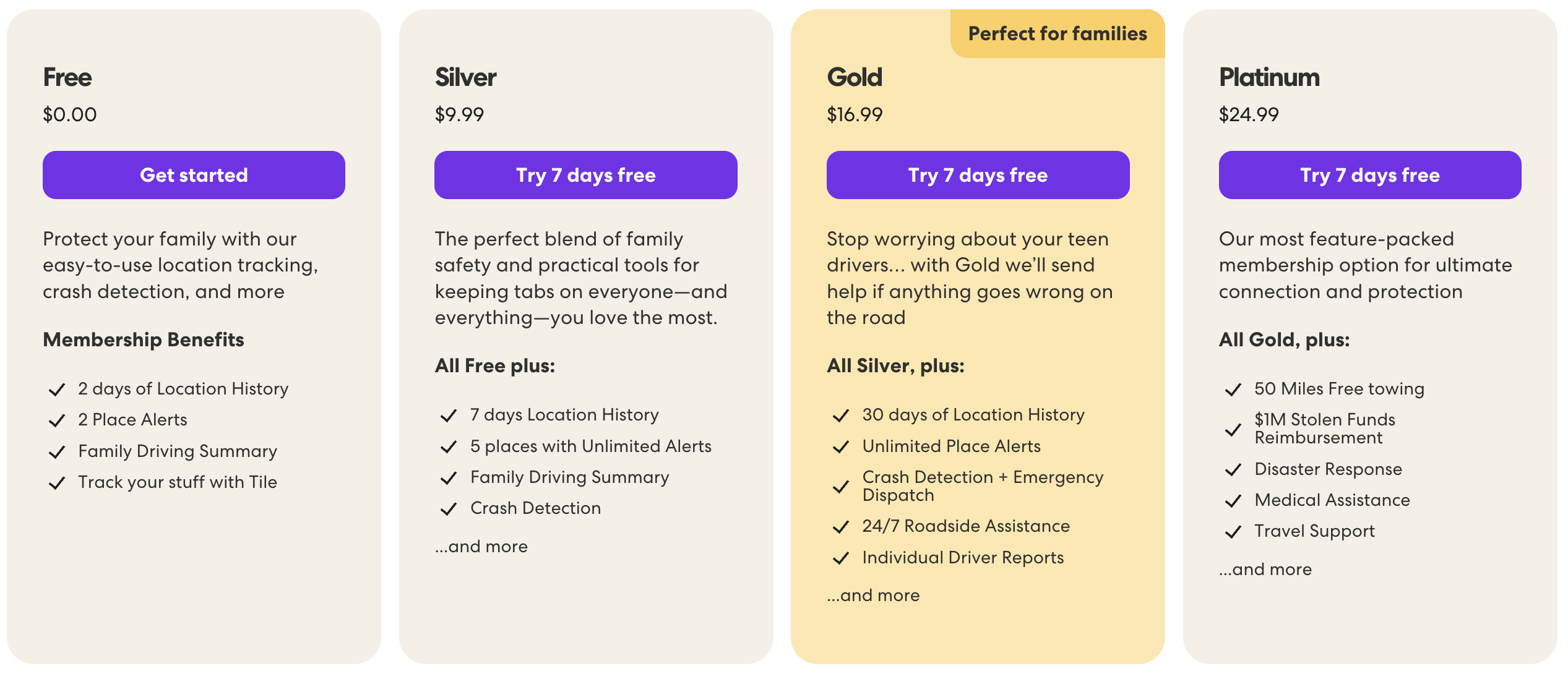
Plan cards, as shown on the page
| Free | Silver | Gold | Platinum |
|---|---|---|---|
| $0.00/mo | $9.99/mo, save 17% annual | $16.99/mo, save 27% annual | $24.99/mo, save 17% annual |
| Try 7 days free | Try 7 days free | Try 7 days free | |
| "Protect your family with our easy-to-use location tracking, crash detection, and more" | "The perfect blend of family safety and practical tools for keeping tabs on everyone, and everything, you love the most." | "Stop worrying about your teen drivers... with Gold we'll send help if anything goes wrong on the road" | "Our most feature-packed membership option for ultimate connection and protection" |
| Membership Benefits | All Free plus: | All Silver, plus: | All Gold, plus: |
|
Badged "Perfect for families" |
|
|
Worth flagging again here. The annual discount isn't flat across tiers (17% / 27% / 17%), Gold gets the deepest annual discount of the three, which lines up with Gold being the tier that carries the headline safety feature (Finding 1). And the FAQ near the bottom of the same page states Gold costs $14.99/month, directly contradicting the $16.99/month shown on the plan card above, see the FAQ section below.
Full feature comparison matrix ("Compare Life360 Plans")
| Feature | Silver | Gold | Platinum |
|---|---|---|---|
| Location Safety | |||
| Covers Members in Your Circle | ✓ | ✓ | ✓ |
| Crash Detection | ✓ | ✓ | ✓ |
| SOS Help Alert | ✓ | ✓ | ✓ |
| No Show Alerts | ✓ | ✓ | ✓ |
| Individual Driver Reports | — | ✓ | ✓ |
| Place Alerts | 5 places | Unlimited places | Unlimited places |
| Location History | 7 days | 30 days | 30 days |
| Emergency Services | |||
| Emergency Services Dispatch | — | ✓ | ✓ |
| Roadside Assistance | — | ✓ | ✓ |
| Free Towing | — | Up to 5 mi | Up to 50 mi |
| Stolen phone protection | Up to $100 | Up to $250 | Up to $500 |
| Stolen funds reimbursement | — | Up to $25k | Up to $1M |
| ID Theft Protection / Personal Safety | |||
| Crime Reports | — | — | ✓ |
| Credit Monitoring | — | — | ✓ |
| Subscription Tracker | — | — | ✓ |
| Disaster Response | — | — | ✓ |
| Medical Assistance | — | — | ✓ |
| Travel Support | — | — | ✓ |
Worth noting for Finding 1 and Finding 2. SOS Help Alert, No Show Alerts, and Crime Reports appear in this detailed comparison matrix but not in the plan cards' own "All X plus" bullet lists above, the two representations of the same tiers don't fully match each other. That's a smaller version of the same self-consistency issue as the Gold price discrepancy: a careful buyer comparing the cards against the matrix would notice the gap. Also confirms Finding 2's framing directly, every ID Theft Protection / Personal Safety row is Platinum-only, all six benefits arrive in one bundle, none available as a standalone add-on at any tier.
Marketing copy, by section
- Free tier framing: "Family Safety That's Always Free... Life360 gives you peace of mind without the price tag." Free is pitched as permanently viable, not just a trial funnel, consistent with the free-tier-as-acquisition-hook pattern noted in What's Already Working.
- Tile cross-sell: "Keep Your Stuff Safe... let Life360 Tile become your partner in pinpointing exactly where your kid left their headphones." Tile is positioned as a companion product sold alongside membership, not folded into a single price, a genuine separate upsell surface (physical hardware, not just a software entitlement) worth understanding the attach rate on.
- Driving section: "Got a teen driver? We so got you... Life360 Gold and Platinum are the key." States outright that Gold is the entry point for the teen-driver use case, direct textual confirmation of Finding 1's framing, it's not an inference, the page says it.
- Digital Safety section: "With Life360 Platinum, you get the tools to help protect your crew's private info, stop fraud in its tracks..." Confirms the ID-theft/credit-monitoring bundle is marketed as a single, undifferentiated Platinum unlock, the exact bundling pattern Finding 2 addresses.
- Social proof: "100 million members... 4.8 star rating on the App Store and a 4.5 star rating on Google Play," with three testimonials (Jessup, Kris O., Wes J.), all location-sharing and driving-related, none referencing Platinum-tier partner benefits, worth noting since it means the page's own testimonial selection doesn't reinforce the Platinum upsell the way the feature copy does.
- Gifting: a dedicated "Gift peace of mind that lasts all year" CTA for gifting a Gold membership, an acquisition channel outside the standard self-serve funnel entirely, worth asking whether gifted memberships convert to self-renewed better or worse than self-purchased ones.
FAQ, as shown on the page
| Do Life360 membership plans cover everyone in my family? | "Yes! The features and benefits of our Silver, Gold, and Platinum memberships cover all the family members in your Circle." |
| Does Life360 offer a free trial? And what does it include? | "Yes, all our membership plans include a 7-day free trial. After the free trial, the membership plan automatically renews. There's no commitment, and you can cancel at any time." |
| How much does a Life360 membership cost? | "Along with our free membership, Life360 also offers paid tiers for additional benefits. Our Gold membership costs $14.99 per month, and our Platinum membership costs $24.99 per month." (Note: contradicts the $16.99/month shown on the Gold plan card above, and omits Silver's price entirely, see Finding 1.) |
Also worth noting. "There's no commitment, and you can cancel at any time" is the FAQ's own cancellation claim, worth testing directly against the actual in-app cancellation flow once I've walked it (see A Note on Scope).
Signup & onboarding walkthrough
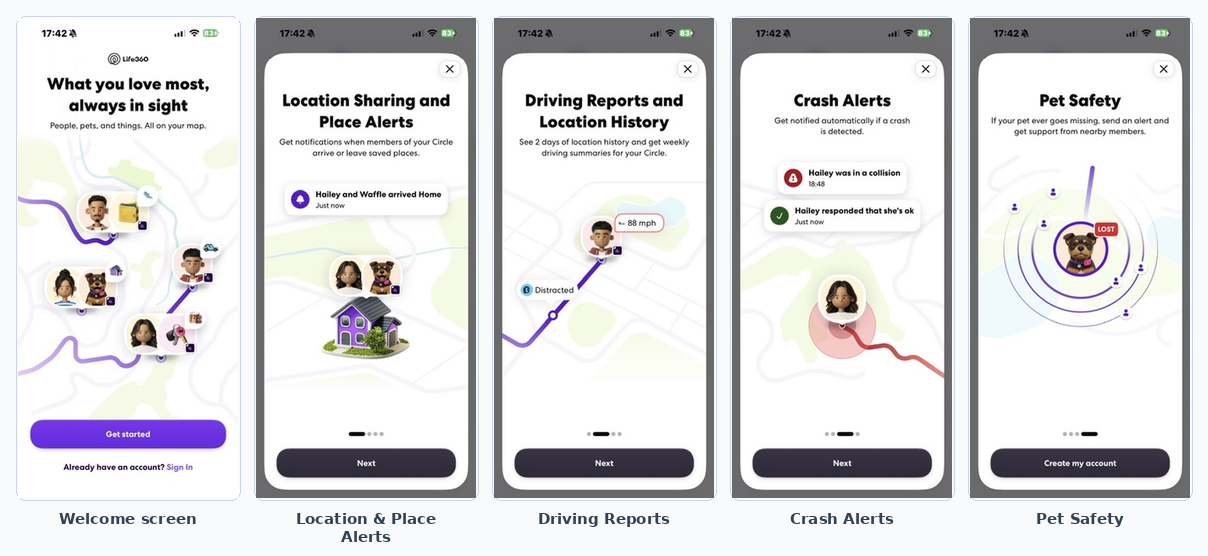
Captured firsthand on iPhone, August 2026: downloaded the app and created a real account through the point just before payment. Verification code redacted.
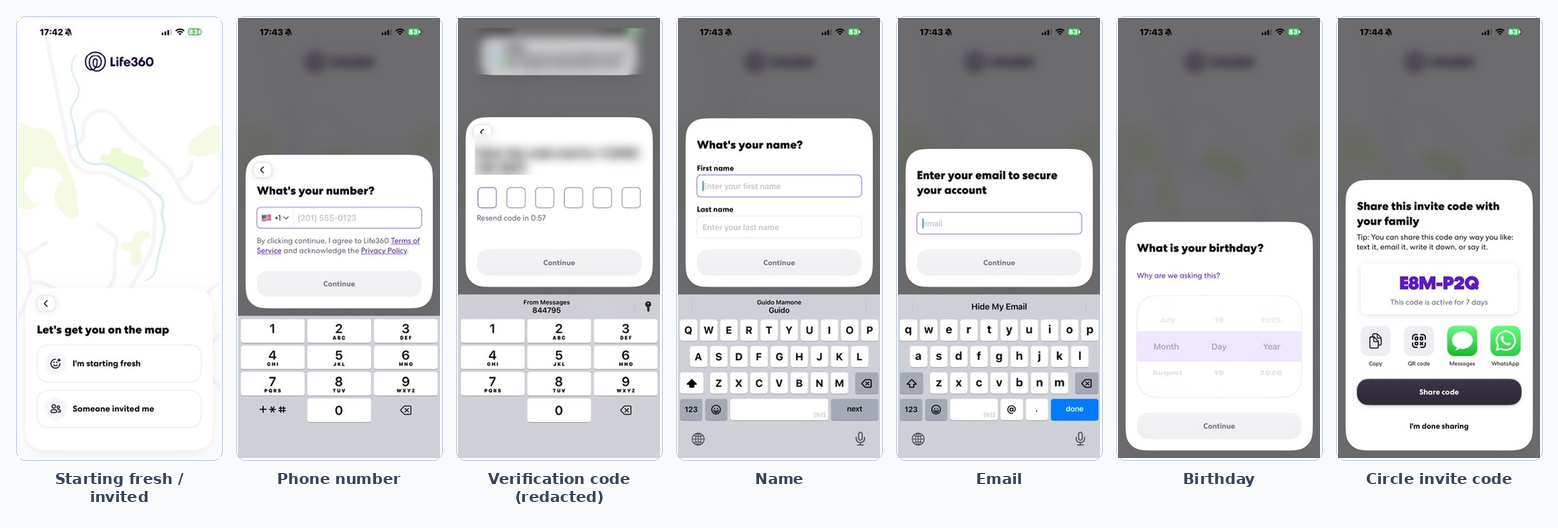
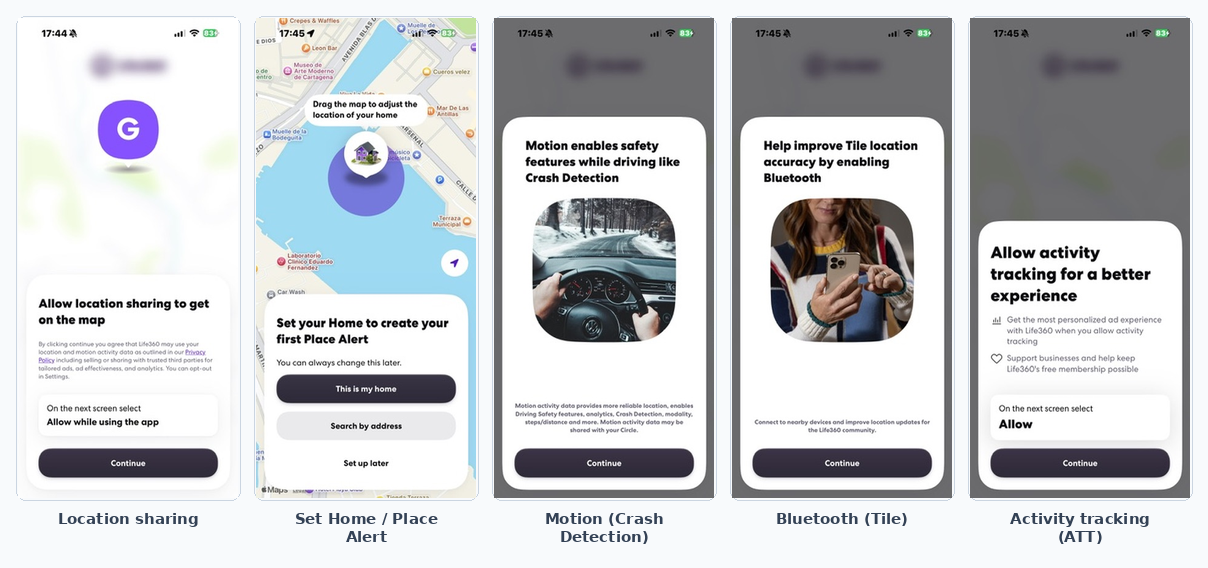
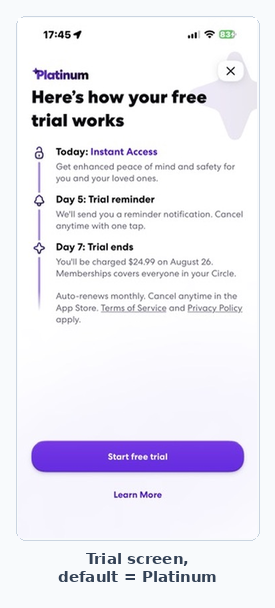
Stopped short of starting the trial, so the actual payment screen, the in-app upgrade/downgrade flow between tiers, the App Store subscription management screen, and the cancellation path are still uncaptured. I'll build those out (in the style of the JamLoop and Net32 teardowns) closer to a later round.
Competitor Analysis
Research-only for now, positioning and business model, not a live product walk. Life360's competitive set splits into two very different groups: free, bundled platform features that erode the low end of the market, and paid, narrower specialists that compete for the trust-and-service premium at the high end.
- Apple Find My / Google Family Link. The most structurally dangerous competitors precisely because they're free and pre-installed, not because they're better. Find My covers location sharing and device finding; Family Link adds screen-time and app controls. Neither offers crash detection with live dispatch, roadside assistance, or identity/financial protection, Life360's actual paid differentiation, but both are "good enough" for a large share of the free-tier audience who will never feel a reason to pay. The real competitive question isn't feature parity, it's whether Life360's paid tiers keep making an increasingly obvious case for why platform-native free tools aren't enough.
- Bark, Qustodio, and other parental-control specialists. Compete on the screen-time/content-monitoring axis Life360 doesn't lead with. Less of a direct threat to the core location/safety proposition, more of a signal that the "family safety software" category is fragmenting into specialists rather than consolidating into one app, worth having a point of view on whether Life360 should broaden toward them or stay focused on location and driving.
- Standalone identity-protection and roadside brands (Aura, LifeLock, AAA). The real competitive test for Finding 2's bundling question: a family already paying AAA for roadside assistance or Aura for identity protection has less reason to value Life360's Platinum bundle at $24.99/mo, since they're already paying elsewhere for pieces of it. Worth knowing whether Life360's own churn or win-rate data shows this substitution pattern.
The pattern worth naming in the room. Life360 isn't really fighting one category of competitor, it's fighting a free floor (Apple/Google) pulling the bottom of the market down, and a set of specialist paid services (AAA, Aura) each individually cheaper than Platinum pulling the value proposition of the bundle into question. The Platinum bundling question in Finding 2 is really this competitive dynamic in miniature: prove the bundle is worth more together than its parts are separately, or risk losing high-intent buyers to whichever specialist they already trust for that one thing.
1. The single most emotionally resonant safety feature sits one paid tier above the entry plan
What I saw. Life360's public pricing page lists four tiers: Free ($0), Silver ($9.99/mo), Gold ($16.99/mo), and Platinum ($24.99/mo), each with a 7-day free trial and its own annual discount, 17% for Silver, 27% for Gold, 17% for Platinum, not a flat rate across tiers. Crash Detection exists in Silver, but Crash Detection with live Emergency Dispatch, the version that actually calls for help, is a Gold-tier feature, alongside 24/7 Roadside Assistance and Individual Driver Reports. Silver's real additions over Free are mostly capacity increases (7 days of location history vs. 2, 5 places with unlimited alerts).7
Why it matters. Crash Detection with Emergency Dispatch is the feature Life360's own company description leads with, "crash detection with emergency dispatch" is a headline safety pitch, and the pricing page's own driving-focused copy ("Stop worrying about your teen drivers... with Gold we'll send help if anything goes wrong on the road") leads with the exact same feature. If that's the headline reason a worried parent converts to paid, and it's gated one tier above the entry paid plan, the pricing ladder is asking a first-time buyer to clear a second decision (is the extra $7/month worth it) before they get the feature that made them consider paying at all. That's a real tension between "what converts people" and "what tier structure earns the most revenue per plan," and it's exactly the kind of tier-architecture call worth making explicitly ("what belongs in each tier... what gets unbundled").
What I'd do. This isn't automatically "move Emergency Dispatch to Silver", that could be the wrong call financially, Gold's ARPPC contribution may depend on it. The actual first move is finding out which it is: does the Gold-gate cost more in abandoned first-time conversions than it earns in incremental tier revenue? That's answerable with existing funnel data (conversion rate at the Silver paywall vs. the Gold paywall, segmented by whether the visit followed a safety-intent trigger like a teen driver setup) before touching the tier architecture itself. Separately, and lower-effort: the pricing page's own FAQ states "Our Gold membership costs $14.99 per month," while the plan cards two sections above it list Gold at $16.99/month.7 That's a small thing to fix, but it's the kind of self-inconsistency that undercuts exactly the trust story that matters most here, a buyer who notices two different prices for the same tier on the same page has a very legitimate reason to double-check everything else on it too.
The metric. Paywall-to-purchase conversion rate, split by tier shown and by acquisition intent (teen-driver setup vs. general family tracking vs. senior/aging-parent setup, three distinct emotional entry points Life360's own marketing pages already segment by). Silver-to-Gold upgrade rate and the median time-to-upgrade, to see whether people who start on Silver are actually completing the jump to the safety feature, or stalling.
The hedge. The Gold gate may be working exactly as designed. The badge, the deepest annual discount, and the driving copy all steer buyers straight to Gold, and if most converts skip Silver entirely, the "cliff" costs almost nothing while the gate protects Gold's price point. It's also possible Crash Detection without live dispatch satisfies most Silver buyers, who mainly wanted the alert, not the ambulance. This is why the finding proposes a data pull, not a tier change: if Gold-first conversion is already dominant and healthy, the right move is leaving the ladder alone and fixing only the $14.99/$16.99 self-contradiction.
2. Real, differentiated partner value is bundled as one flat jump instead of legible, addressable value
What I saw. Platinum ($24.99/mo) adds, all at once over Gold: 50 miles of free towing, $1M Stolen Funds Reimbursement, Disaster Response, Medical Assistance, Travel Support, and Credit Monitoring, on top of a strategic partnership with Allstate on driving and insurance data.73 Each of these is a genuinely different kind of value (financial protection, travel logistics, identity monitoring, medical support), aimed at different member concerns, but they're only available as one indivisible $8/month step above Gold.
Why it matters. This is a strategic choice worth naming directly: what gets bundled, what gets unbundled. A family primarily worried about identity theft and a family primarily worried about roadside breakdowns are both being asked to buy the same $24.99 bundle to get either benefit, even though those are genuinely different buyers with different willingness to pay for each individual service. That's not necessarily wrong, bundling can raise average revenue and simplify the decision, but it's a real tradeoff against addressable, higher-intent upsells (a family that never drives long distances may never value roadside assistance enough to justify the jump, even though they'd pay for credit monitoring alone).
What I'd do. Before proposing unbundling (which carries real engineering and pricing-page complexity cost), I'd want the segmentation data: does willingness-to-pay for the individual partner services actually diverge by household type, or does bundling already capture close to the same revenue with far less complexity? If it diverges meaningfully, the lowest-risk test isn't full unbundling, it's message-testing individual partner benefits as the featured reason to upgrade to Platinum (rotating which one leads, roadside vs. credit monitoring vs. disaster response) to see which single benefit actually drives the upgrade decision, before deciding whether the bundle itself needs to change.
The metric. Platinum upgrade rate segmented by which partner benefit is featured in the upsell messaging. Partner-service utilization rate post-upgrade (are Platinum members actually using roadside assistance, credit monitoring, etc., or paying for a bundle they don't touch, a leading indicator of future churn). Partner cost-per-claim/service against Platinum's incremental ARPPC, to know whether the bundle is actually profitable at scale, not just well-received.
The hedge. Flat bundling may already be close to optimal. Bundling benefits that different households value differently is a legitimate way to capture heterogeneous willingness to pay in one price (the classic inverse-correlation logic from Monetizing Innovation), and low utilization isn't automatically a problem, Platinum is partly insurance, and insurance margins depend on most people not claiming. Partner contracts may also make unbundling contractually or economically impossible in ways invisible from outside. That's why the proposal is a messaging test, not a repackaging.
3. Silver looks like a tier, works like a decoy, and is built to be neither
What I saw. Finding 1 looked at the Silver/Gold boundary from the feature side; this is the same ladder viewed from the tier side. Silver's additions over Free are capacity increases (7 days of history vs. 2, 5 places vs. 2), what Monetizing Innovation would call filler features, while Gold holds the leader feature the marketing story runs on. Meanwhile Life360's own pricing page treats Gold as the default in every way it can: Gold gets the only badge ("Perfect for families"), the deepest annual discount (27% vs. 17%), the emotional driving copy, and the FAQ that quotes prices for Gold and Platinum omits Silver's price entirely.7
Why it matters. A tier can earn its place two ways: as a real product with a distinct value proposition, or as a deliberately engineered decoy that makes the target tier the obvious compromise (Ariely's Economist experiment in Predictably Irrational: a decoy option nobody chose shifted 52% of buyers to the higher-priced plan). Silver currently does neither job well. As a product, it has no leader feature, it sells "more of the free tier." As a decoy, it's mis-built: it sits $7 below Gold (a wide gap to anchor across) and differentiates on capacity when the purchase driver is safety, so it doesn't tee up the Gold comparison, it competes with Free. Tier architecture is literally the first bullet of this JD ("what's in each tier"), and a four-tier ladder where one tier has no clear job is either leaving conversion on the table or quietly diluting ARPPC, worth knowing which. There's also a precedent that pruning can pay: Teamwork.com lifted ARPU ~20% just by removing unnecessary tiers (cited in Product-Led Growth).
What I'd do. Pull the tier mix first: what share of new payers enter on Silver, and how does their 6-month retention and upgrade behavior compare to Gold-first converts? If Silver is a small share of new payers and retains worse, two tests, in order of ambition: (a) rebuild Silver as an explicit decoy, repositioned so the Gold comparison is unavoidable (closer price, framed as "Gold minus the safety net"), and (b) painted-door a three-tier ladder with no Silver at all, measuring paywall conversion and blended ARPPC. Existing Silver subscribers get grandfathered either way, changing entitlements under paying members is one of the fastest ways to spike cancellation and complaint volume.
The metric. Share of new subscriptions by entry tier, and 6-month retention by entry tier. Paywall-to-purchase conversion and blended ARPPC in the 3-tier vs. 4-tier test. Silver-to-Gold upgrade rate (shared with Finding 1), since a "starter tier" that nobody graduates from isn't a starter tier, it's a dead end.
The hedge. Silver may serve a segment invisible from outside: price-sensitive international markets, win-back offers, downgrade-instead-of-cancel saves, or legacy migrations from the pre-membership SKUs. It may also already be doing quiet decoy work, its mere presence on the page anchoring Gold as reasonable, in which case removing it would hurt Gold conversion even though Silver itself sells little. Only the tier-mix and downgrade-path data settles this, which is why the first step is a query, not a redesign.
4. The 7-day trial ends before the product can prove what members actually pay for
What I saw. Every paid tier carries the same 7-day free trial.7 But Life360's paid value is insurance-shaped: crash detection with dispatch, roadside assistance, stolen-funds reimbursement are all things a family hopes never to use, and statistically won't use in any given week. A 7-day trial of Netflix proves Netflix. A 7-day trial of Life360 Gold can only prove the monitoring, never the rescue, the feature the buyer is actually paying for stays invisible unless something goes wrong on exactly the right week.
Why it matters. RevenueCat's 2026 benchmark data (115,000+ apps) shows trials of 17–32 days converting at a 42.5% median versus 37.4% for 5–9 day trials and 25.5% for 4 days or less, longer trials convert roughly 70% better than the shortest ones, yet nearly half the industry keeps shortening trials anyway.8 The same dataset shows over half of trial cancellations happening on Day 0, before the product has done anything at all. For a product whose time-to-value is event-driven rather than calendar-driven, trial length and trial content are both live levers, and the experimentation platform is there to test exactly this.
What I'd do. Three tests, cheapest first. (a) Engineer proof-of-value inside the existing trial: a weekly "protection recap" (drives monitored, hard-braking events flagged, dispatch on standby the whole time) that makes the invisible insurance visible, the same restate-the-value mechanic subscription products use before renewal. (b) Test a 14–30 day Gold trial specifically for safety-intent signups (teen-driver setups), where the longer window raises the odds of a real value moment landing before the payment decision. (c) Test a reverse trial for engaged free users, granting Gold temporarily after a paywall dismissal; RevenueCat documents one app moving freemium conversion from 0.4% to 4.5% with exactly this mechanic.8
The metric. Trial-to-paid conversion by trial-length cohort, plus Day 0 trial cancellation rate as its own line. Percentage of trialers who experience at least one safety-relevant moment (place alert fired, driving report generated, recap opened) before expiry, and conversion conditioned on that, if conditioned conversion is much higher, the recap test matters more than the length test. Guardrail: 60–90 day retention of converts by trial length, so a longer trial isn't just deferring the same churn.
The hedge. RevenueCat's medians are cross-category, and safety apps may not follow them, the anxiety that drives a Life360 conversion may peak on Day 0 and decay, in which case a longer trial loses urgency instead of gaining proof. Longer trials also delay revenue, complicate Apple/Google trial-eligibility mechanics, and widen abuse surface. And a team that runs its own experimentation platform has plausibly already tested trial length, so the first move is asking what that test showed, not proposing to rerun it.
5. The free tier's caps throttle the same engine that produces payers
What I saw. Free members get 2 days of location history and 2 place alerts.7 Those two caps sit on the two different psychological surfaces a freemium tier has: place alerts are the habit surface (every alert is a push notification that re-opens the app and re-runs the check-in loop), and location history is the endowment surface (accumulated data a member would lose by walking away). Both are capped to near-zero.
Why it matters. The analytical core of Freemium Economics is that retention is the primary freemium metric and that the small fraction of users who will ever pay reveal themselves only through engagement behavior over time, you cannot identify the payers inside a free base that doesn't come back. Place alerts are the product's built-in external trigger in the Hooked sense, and capping them at 2 caps the trigger frequency, which caps retention, which shrinks the observable pool the entire paid funnel draws from. Meanwhile 2 days of history builds no endowment at all: there's nothing accumulating that a free member would feel loss-averse about losing. The sharper architecture is asymmetric: generous on habit features (alerts), deliberately stingy on endowment and depth features (history), so the free tier builds the comeback loop while the upgrade unlocks what the member has already started to value. Today's free tier is stingy on both, so it neither retains nor endows, and every free member it fails to retain is a member the ad business also never monetizes.
What I'd do. A holdout test expanding free place alerts (2 → 5, the current Silver quantity) for a new-signup cohort, judged on D30 retention and 30/60/90-day free-to-paid conversion, explicitly not on short-term paywall hits, the hypothesis is that more triggers produce more safety-relevant moments, which is the exact top of the funnel I'd instrument in How I'd Measure It. Pair it with the reverse-trial mechanic from Finding 4 so the endowment side gets its own test: let an engaged free member taste 30 days of history, then let loss aversion argue for the upgrade at expiry.
The metric. D1/D7/D30 free-member retention by cap variant, alerts configured per free circle, and free-to-paid conversion at 30/60/90 days per cohort. Guardrail: Silver and Gold conversion among the expanded-cap cohort, since the test deliberately gives away part of what Silver sells, and the whole question is whether habit-driven conversion gains outrun the cannibalized capacity upsell.
The hedge. The cannibalization risk is real and is the honest counterargument: "more places" is a real share of Silver's pitch, and loosening it may simply delete the cheapest upgrade reason. More alerts can also backfire as notification fatigue (more pings, more muted notifications, less engagement, and OS-level notification permissions revoked, which for this product is close to fatal). And at 102M MAU, even small per-user increases in push volume and location processing carry real infrastructure cost. The current caps may also already be the output of exactly this experiment, another "what did the last test show" question before proposing a rerun.
6. The product is sold per circle, but the pricing story is told per person
What I saw. The pricing page FAQ confirms one membership covers every member of the circle.7 Yet the page presents $16.99/month the way a single-user app would: one price, one implied buyer, testimonials from individuals. The one surface that does treat someone else as the economic buyer, the "gift a Gold membership" CTA, sits at the bottom of the page as an afterthought, and the page's own testimonials never reference it.
Why it matters. Two separate levers hide inside this. First, framing: willingness to pay here is household-level, and "$16.99 a month" is a psychologically different price than "full protection for all five of you, about $3.40 per person", the pennies-a-day mechanic from the pricing literature, applied to a buyer who is already thinking about the whole family because that's what the product is for. Second, growth: in Cold Start Problem terms, the circle is Life360's atomic network, every invite a member sends is zero-CAC acquisition that arrives pre-activated (they were invited by the person they'd share location with), and the invite flow compounds in a way no paywall optimization can. A subscriber-value role that only optimizes paywalls is leaving the cheaper machine untouched: bigger completed circles plausibly mean more alert triggers, more safety moments, more reasons for the one payer to keep paying.
What I'd do. (a) A/B per-member price framing on the paywall and pricing page, dynamically computed from actual circle size ("covers all 4 people in your circle"), with careful copy so it reads as included value, not as per-seat billing. (b) Instrument the invite funnel (invite sent → app installed → circle joined) as a first-class growth metric with an owner, and measure conversion probability against completed circle size. (c) Answer the gifting question the page already raises: do gifted memberships self-renew better or worse than self-purchased ones? If better, grandparents are an underworked second-payer channel; if worse, gifting is a leaky discount and should be repositioned.
The metric. Paywall conversion, per-member framing vs. standard. Invite completion rate and median circle size at conversion vs. non-conversion. The k-factor of circle invites (new members per existing member, per Freemium Economics). Gifted-membership self-renewal rate at first anniversary vs. self-purchased.
The hedge. Per-member framing can misfire if it reads as "everyone will be charged", exactly the kind of billing-surprise this brand can't afford, so the copy test matters as much as the math. Circle size correlating with conversion wouldn't prove causation (bigger families may simply be higher-intent from day one). And at 102M MAU the easy invite loops may be saturated, incremental invite optimization could be small. The framing test is cheap either way; the invite-funnel investment deserves the correlation data first.
What's already working
Four things worth protecting exactly as they are, since a "fix everything" mandate risks breaking what's already earning its keep.
- ARPPC grew alongside volume, not instead of it. Paying circles up 27% YoY and ARPPC up 5% YoY in the same quarter is the opposite of the classic freemium trap (growth bought by discounting). Whatever pricing discipline is producing that combination is worth understanding before changing anything upstream of it.
- A real second revenue engine, not a bolt-on. 315% YoY ad-revenue growth post-Nativo is a genuine diversification win most subscription businesses would want.
- The free tier already includes a real hardware hook. Tile tracker integration sitting in the Free tier, per the pricing page, is a smart low-cost acquisition lever: a tangible product benefit before any payment, worth protecting as-is.
- The partner roster is genuinely differentiated. Roadside assistance, stolen-funds reimbursement, and disaster response aren't features a competitor can copy by shipping code, they require real partnerships (Finding 2 is about packaging them better, not about the partnerships themselves being weak).
How I'd measure it
North star. Revenue per paying circle (ARPPC), the metric Life360 already reports externally. It's the right north star here specifically because, like RPV in a marketplace, it can't be gamed by a change that adds circles without adding value, or a change that raises price without holding retention, both failure modes a narrower metric (raw signups, raw revenue) would miss.
The guardrail I'd hold myself to. Voluntary churn and cancellation-complaint volume, tracked as their own line, not folded into a blended churn number. A tier redesign or ad-placement change can lift short-term ARPPC while quietly eroding the trust the whole business is built on. If ARPPC rises while voluntary churn or complaint volume rises with it, that's the signal the win isn't real.
The funnel I'd instrument. Free signup, first safety-relevant moment (place alert, driving report, crash-detection trigger), paywall view, tier selected, purchase, and, critically, the two stages most subscription funnels under-instrument: renewal decision (auto-renewed vs. actively re-confirmed) and cancellation path, plus partner-service activation and utilization post-upgrade for Platinum specifically. And upstream of all of it, the circle invite funnel (invite sent → installed → joined), since per Finding 6 every completed invite is zero-CAC acquisition that feeds everything downstream.
Where I'd start
- 1 Get the segmented conversion data behind the Silver/Gold safety-feature gate. A data pull, not a redesign, this tells us whether Finding 1 is a real problem before any tier architecture changes.
- 2 Run the Platinum benefit-messaging test. Lowest-risk way to learn whether the partner bundle should stay flat or move toward addressable upsells, no engineering rework of the bundle itself required to start.
- 3 Pull the tier mix and the trial-history archive. One query answers whether Silver has a job (Finding 3), and one conversation with whoever owns the experimentation platform answers whether trial length and free-tier caps have already been tested (Findings 4 and 5), before proposing to rerun anything.
Ideas to test
Seven concrete, testable ideas, each grounded in something actually observable from outside the company plus the specific lever it maps to. None require internal data to propose, though all need it to run.
- 1 Safety-intent-segmented paywall. Show the Gold-tier Emergency Dispatch benefit earlier in the paywall sequence specifically for teen-driver-intent signups, without changing the underlying tier price. Hypothesis: safety-intent segments convert to Gold at a meaningfully higher rate when the feature that matches their stated concern leads the paywall.
- 2 Rotating Platinum benefit spotlight. A/B the featured partner benefit in the Gold-to-Platinum upsell (roadside, credit monitoring, disaster response) across otherwise-identical audiences. Hypothesis: upgrade rate varies meaningfully by which benefit leads, evidence for whether unbundling is worth the engineering investment.
- 3 Annual-plan framing at the cancellation moment. For members attempting to cancel a monthly plan, test surfacing the 27% annual-savings framing as a retention offer, distinct from a discount, since it's a real, already-existing price benefit, not a new concession. Hypothesis: this recovers a meaningful share of price-sensitive voluntary cancellations without training members to expect a discount for threatening to leave.
- 4 Protection recap during the trial. A weekly in-trial summary that makes the insurance-shaped value visible (drives monitored, events flagged, dispatch on standby). Hypothesis: trialers who see at least one recap convert meaningfully better, because the trial finally demonstrates the thing the buyer is paying for (Finding 4).
- 5 Reverse trial for engaged free members. Grant temporary Gold access after a paywall dismissal, then let the endowment argue at expiry ("your 30 days of history goes back to 2"). Hypothesis: conversion among engaged free users beats the standard paywall path, per the 0.4% → 4.5% freemium case in RevenueCat's dataset (Findings 4 and 5).8
- 6 Expanded free alert caps, judged at D30. Raise free place alerts from 2 to 5 for a new-signup holdout, measured on D30 retention and 30/60/90-day conversion, with Silver/Gold conversion as the cannibalization guardrail. Hypothesis: the habit loop the extra triggers build produces more converts than the capacity upsell loses (Finding 5).
- 7 Per-member price framing on the paywall. Compute the per-person cost from the buyer's actual circle ("covers all 4 of you, about $4.25 each") and test it against the standard single price, with copy engineered so it can't read as per-seat billing. Hypothesis: household framing lifts conversion for multi-member circles without touching price at all (Finding 6).
From my own work. Two of these ideas are close cousins of things I've shipped before. At Ligas Flex, rewriting every error message and validation moment across the signup and payment flow, on top of reducing required fields, moved payment completion up 50%, the same "friction sits quietly in a flow nobody audited end to end" pattern worth applying to any conversion flow here. At DIRECTV, retiming a free-trial offer to align with actual buyer intent (soccer match days) rather than running it as an always-on promotion lifted paid conversion 15%, the same logic behind segmenting the safety-intent paywall test. I've also run a pricing test that failed outright (Mexico, Allianz), which is part of why I'd insist on the segmented data before touching the Gold-tier gate itself, not just a strong opinion.
A note on scope
This was built entirely from Life360's public pricing pages, its own investor-relations disclosures and Q2 2026 earnings release, BBB's public complaint register, public regulatory tracking of the FTC's click-to-cancel rulemaking, and, for Findings 4 and 5, cross-category industry benchmarks from RevenueCat's State of Subscription Apps 2026, which are priors about the market, not measurements of Life360. I do not currently hold a paid Life360 membership, so the actual upgrade flow, in-app cancellation path, App Store/Google Play subscription management screens, and ad placement and frequency inside the app are all unverified from firsthand use, that's the natural next step, in the same screen-by-screen format as the JamLoop and Net32 teardowns, and I'd plan to do it before or shortly after a later round. No internal churn, cohort, entitlement-config, or experimentation data was available at any point. Every finding, priority, and metric above is a hypothesis built from outside evidence, not a confirmed diagnosis.
Notes
- Life360 CEO transition: Chris Hulls to Executive Chairman, Lauren Antonoff to CEO, announced August 2025. Sources: Life360, "Transitioning to Life360's Executive Chairman"; GlobeNewswire, "Life360 Names COO Lauren Antonoff as Chief Executive Officer". ↩
- Q2 2026 financial results (MAU, paying circles, revenue, ARPPC, guidance). Source: StockTitan, "Life360 Q2 Earnings: Revenue Hits $159M, Up 38%", corroborated against Life360 investor relations, "Life360 Reports Record Q2 2026 Results". ↩
- Tile and Nativo acquisitions, Allstate partnership. Sources: Life360, "Tile Joins Life360"; Life360, "Life360 Completes Acquisition of Nativo"; Life360, "Life360 and Allstate Form Strategic Relationship". ↩
- FTC "click-to-cancel" rule finalized 2024, vacated by the Eighth Circuit in July 2025, days before the compliance deadline. Source: Latham & Watkins, "Eighth Circuit Vacates FTC's Click-to-Cancel Rule Days Before Compliance Deadline". ↩
- FTC restarted negative-option rulemaking in 2026 and continues enforcement under ROSCA; state automatic-renewal laws remain active in parallel. Source: Gibson Dunn, "FTC Restarts Negative Option Rulemaking After Eighth Circuit Vacatur"; Jones Day, "FTC Revives Click-to-Cancel Rule: New Risks for Subscription Businesses". ↩
- Life360 membership tier pricing, full feature comparison matrix, and FAQ (Free, Silver, Gold, Platinum), including the Gold price discrepancy between the plan card ($16.99/mo) and the FAQ ($14.99/mo). Source: Life360, "Plans & Pricing", captured August 2026, full page text archived in the Their Plans section above; features and prices subject to change. ↩
- Industry benchmarks for trial length vs. trial-to-paid conversion (17–32 day trials: 42.5% median vs. 25.5% for ≤4 days), Day 0 trial-cancellation shares, and the reverse-trial case (freemium conversion 0.4% → 4.5%). Source: RevenueCat, "State of Subscription Apps 2026", a dataset of 115,000+ apps and $16B+ in tracked subscription revenue. Cross-category medians, used here as priors, not as Life360-specific claims. ↩